
Table of Contents
A mis-sized greenhouse fogging system fails in two directions, and both cost money. Under-cooled, the canopy runs 3 to 5 °C above setpoint at solar peak. Stomata close, photosynthesis slows, and fruit set falls within days. Over-cooled with coarse spray, droplets above 100 micron rain onto leaves. Water films then sit on foliage for 30 to 60 minutes, and botrytis or downy mildew appears 48 to 72 hours later.
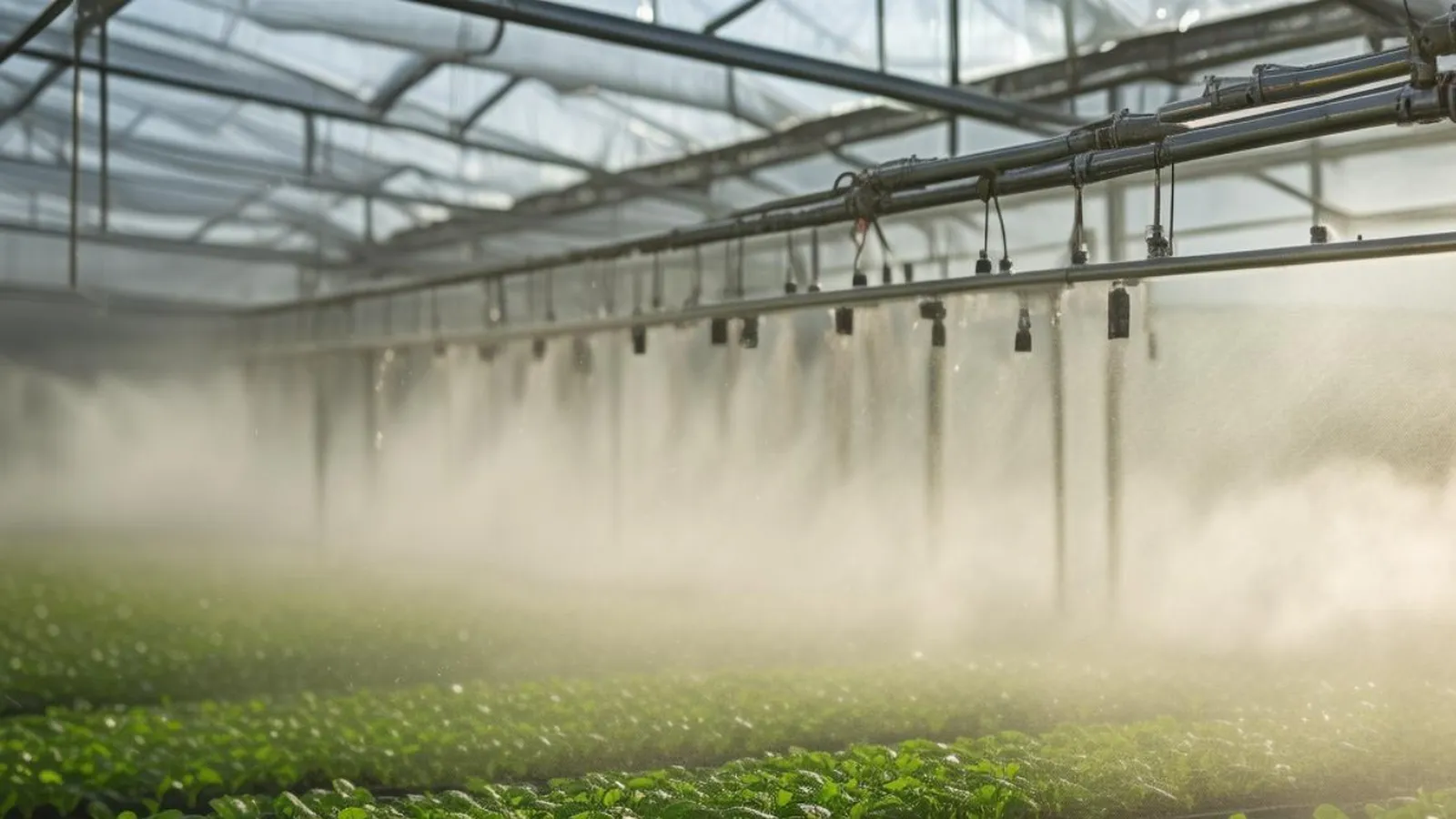
Good greenhouse fogging systems sit between those failures by arithmetic, not guesswork. The heat load in kW divides by the latent heat of water to give liters per hour. The droplet band decides whether fog evaporates or rains on the crop. Nozzle flow, spacing and layout decide whether every square meter gets the same dose. This guide sizes an evaporative cooling package for a 1,000 m2 house, step by step.
The Snapshot
- Droplet target for crop-safe fog: VMD below 50 micron; above 100 micron the spray wets leaves instead of cooling air.
- Pressure classes: true fog needs 60 to 100 bar; 2 to 4 bar bodies are wet misters for aisles, not for crops.
- Cooling potential: fully evaporating 100 L/h of water removes 62.8 kW, with practical utilization at 70 to 90%.
- Water quality: feed fogging nozzles below roughly 50 ppm hardness, usually by RO, or expect calcium plating and orifice wear.
Evaporative Cooling Runs on 2.26 MJ per Kilogram
Water absorbs about 2.26 MJ of heat when 1 kg fully evaporates. That is the latent heat of vaporization, and it governs every sizing decision in a fog installation. Fog is surface area handed to the air, and the air pays 2.26 MJ per kilogram it accepts.
Run the constant in reverse and the capacity ceiling appears. Evaporating 1 kg/s absorbs 2.26 MW, so about 0.44 kg/s of evaporation equals 1 MW of cooling. Reversing again, fully evaporating 100 L/h of water removes 62.8 kW. That single figure converts any heat load into a pump and nozzle specification.
Two limits decide whether supplied water actually evaporates. First, droplet path: a droplet must finish shrinking before gravity delivers it to a surface. A 20 micron droplet evaporates during 1 to 2 m of fall; a 200 micron droplet lands in seconds, mostly intact. Second, air capacity, set by wet-bulb depression.
On a 32 °C, 40% RH afternoon the air accepts moisture aggressively. At 32 °C and 80% RH, a greenhouse fogger adds humidity you did not ask for and removes almost no heat. Keep 3 to 5 °C of wet-bulb depression and the water flashes off cleanly.
Below about 2 °C, throttle the fog duty and lean on ventilation instead. Forcing spray into saturated air produces exactly the leaf wetting the system was meant to avoid. The same 2.26 MJ constant also sizes industrial spray cooling, covered in our cooling nozzle selection guide.
Droplet Size Decides Everything: 50 Micron vs 100 Micron
The working threshold for crop-safe fog is a volume median diameter (VMD) of 50 micron or below. Droplets that size have enough surface area per unit mass to evaporate within 1 to 2 s of suspended life. That is longer than the 2 to 3 m fall distance from a typical fog line to the canopy. At 20 micron the evaporation margin is comfortable. At 50 micron it is tight, and past that the physics turns against you.
Above 100 micron, a growing share of droplet mass survives the fall and deposits as liquid water. Leaf wetness duration drives sporulation of botrytis, downy mildew and mycosphaerella on lettuce and tomato. A canopy that dries within 4 to 6 minutes is usually safe. One that holds water films for 30 minutes or longer becomes a disease incubator. Spring houses at 20 to 24 °C are the classic case.
The distribution matters as much as the median. Every nozzle emits a spectrum, so specify the Dv90 point alongside the VMD. The Dv90 is the size below which 90% of spray volume falls. A tip with a 35 micron VMD and a Dv90 of 120 micron still drips, because 10% of its volume rains coarse satellites. The droplet size calculation guide works through reading and converting those spectra.
Satellites are a design defect, not user error. They appear when pressure falls below the rated band of the nozzle, or when a brass orifice wears oval under abrasive water. They also appear when a low-pressure body is sold under the word “fog”. The label changes nothing about droplet physics. A fogger in the greenhouse cools only when pressure makes droplets small enough to vanish.
Pressure Classes: 60 to 100 Bar vs 2 to 4 Bar
Fog quality is bought with pressure. Pressure energy sets droplet size far more reliably than orifice geometry alone. That is why published performance data for a tip family is always indexed by bar, not by hope. The practical classes for greenhouse duty behave as follows.
| Pressure class | Working pressure | Typical VMD band | Evaporation behavior | Typical greenhouse duty |
|---|---|---|---|---|
| High pressure fog | 60 to 100 bar | 5 to 30 micron | Evaporates before contact with crop or floor | Humidity control and cooling over benches |
| Medium pressure | 10 to 25 bar | 30 to 80 micron | Partial flash-off, roughly 60 to 80% in dry air | High-walled houses, corridor cooling |
| Low pressure | 2 to 4 bar | 80 to 300 micron | Mostly lands as wet mist | Aisle and floor cooling, nursery hardening |
| Ultrasonic atomizing | near 0 bar | 1 to 10 micron | Full evaporation, minimal drift | Propagation rooms, small sealed bays |
At 70 bar, high pressure fogging nozzles shear water through a 0.10 to 0.15 mm ruby orifice. The droplet band lands under 20 micron, and the fog behaves like humidity, not like rain. Feed a low-pressure body 3 bar and the best mist it can physically produce sits several times coarser, whatever its datasheet calls it.
High pressure costs money twice: a 60 to 100 bar plunger pump with stainless wet ends, and hard-drawn or 316L tubing with pressure-rated fittings. Low pressure costs less to buy and more to run agronomically. Wet crops bill you in fungicide sprays and rejected fruit. Choose the class from the crop, not from the invoice. If you are weighing fog against ultrasonic atomization for a sealed propagation bay, the ultrasonic evaporative cooling guide compares both against the same load math.
Worked Calculation: 1,000 m2 at 200 kW
Here is the sizing a buyer should reproduce in ten minutes. Assume a 1,000 m2 Venlo-type house receiving 700 W/m2 of solar radiation at noon. Assume ventilation alone cannot shed the load, leaving 200 kW of residual cooling demand. That equals 0.2 kW per square meter of floor. Published warm-climate bands run from about 100 W/m2 with shade cloth to 250 W/m2 under clear glass.
Step 1: convert load to evaporation demand. At 2.26 MJ/kg, removing 200 kW means evaporating 200 ÷ 2,260 kg/s = 0.088 kg/s = 320 kg/h. Call it 320 L/h fully evaporated.
Step 2: apply a utilization factor. Only part of the supplied water flashes off. In a well-laid greenhouse fogging system with 15 micron fog and 3 °C of wet-bulb depression, plan on 80%. The honest planning band is 70 to 90% utilization.
Below 70% you are irrigating the floor; above 90% you should simply buy less hardware. Supply = 320 ÷ 0.80 = 400 L/h.
Step 3: sanity-check against the headline figure. Fully evaporating 100 L/h gives 100 kg/h × 2.26 MJ/kg = 226 MJ/h = 62.8 kWh/h, so 62.8 kW. Our 400 L/h supply evaporates 320 L/h at 80% utilization. That delivers 3.2 × 62.8 = 201 kW. The arithmetic closes.
Step 4: convert to hardware. A standard 70 bar ruby fog nozzle flows about 2 L/h. So 400 ÷ 2 = 200 nozzles over 1,000 m2, roughly one nozzle per 5 m2. Split the lines into four zones of 50 nozzles and 100 L/h each. The controller then stages output as load climbs, instead of hunting between saturated and dry.
Step 5: verify the air can take it. At 32 °C and 50% RH, the house air accepts several hundred liters per hour if exhaust fans export the moisture. If measured RH climbs past 90% with fog on and fans off-cycle, the fault is ventilation, not nozzle count.
Nozzle Flow and Output: the 0.05 to 0.35 gpm Range
Published catalogs for greenhouse mist duty split into two worlds. High pressure fog tips flow fractions of a liter per hour. The fine-mist tip families for low and medium pressure duty are published across a 0.05 to 0.35 gpm range. That converts to roughly 11 to 80 L/h per nozzle.
The table uses typical published class values from supplier data. Always verify against the chart for the exact body you buy.
| Tip class (typical) | Flow per nozzle | In L/h | Expected VMD | Nozzles per 100 m2 | Output per 100 m2 |
|---|---|---|---|---|---|
| HP ruby orifice, fine | 0.003 gpm | 0.7 L/h | 5 to 15 micron | 70 to 100 | 50 to 70 L/h |
| HP ruby orifice, standard | 0.009 gpm | 2 L/h | 10 to 25 micron | 20 | 40 L/h |
| Medium pressure fog tip | 0.05 gpm | 11 L/h | 40 to 80 micron | 4 to 6 | 44 to 66 L/h |
| Low pressure fine mist | 0.15 gpm | 34 L/h | 80 to 150 micron | 2 to 3 | 68 to 102 L/h |
| Low pressure mist jet | 0.35 gpm | 80 L/h | 150 to 300 micron | 1 to 2 | 80 to 160 L/h |
The per-100-m2 columns answer the question buyers actually ask. Take the cooling or humidity demand in L/h from the load calculation. Divide by the evaporated output of one nozzle. Add 20% for future orifice wear and zone staging. Never size upward by buying coarser nozzles; stage finer ones across more zones.
Layout: Bench Geometry vs Walk-Through Aisles
Flow sets capacity; layout decides whether that capacity reaches every plant evenly. Fog evaporates in flight, so the governing distances are nozzle height above the target plane and spacing along the line. The two dominant greenhouse geometries need different answers.
| Layout | Nozzle height | Spacing on line | Line spacing across house | Notes |
|---|---|---|---|---|
| High bench or table crops | 0.5 to 1.0 m above canopy | 0.7 to 1.0 m | 1.5 to 2.0 m | Run lines between benches, above plants |
| Ground beds | 1.8 to 2.2 m | 1.0 to 1.5 m | 2.0 to 3.0 m | Longer fall distance aids flash-off |
| Hanging baskets | 0.3 to 0.5 m above crop | 0.5 to 0.75 m | 1.0 to 1.5 m | Short path: keep VMD under 15 micron |
| Walk-through corridor | 2.0 to 2.5 m, side-mounted | 1.0 to 1.5 m | one line per gutter bay | Aim away from glazing to avoid streaks |
| Propagation bay | 0.4 to 0.6 m | 0.5 m | 1.0 m | Duty is humidity, not cooling |
For bench houses, place lines above the plants, not below the tables. Keep nozzles at least 300 mm clear of wire mesh, which strips droplets from the fog stream. A mesh contact turns a fog line into a drip line. In walk-through houses, run one line under each gutter. Offset nozzles from the glazing, so unevaporated fog never plates the glass with mineral streaks.
Evenness is verified cheaply. Tape water-sensitive paper at canopy height on a 3 by 3 m grid. Run the system for 30 s, then count coverage spots per card. The wettest and driest cards should differ by less than 20%.
A 40% spread means spacing, height or fan interference is wrong. Controller tuning will not hide it.
Water Quality: 50 ppm Hardness or Buy RO
Hard water is the most common killer of greenhouse fog quality. A 15 micron droplet dries to a residue of dissolved solids. Multiply 2 L/h through one nozzle by 150 grains per gallon of calcium carbonate, and you get steady mineral deposition on foliage, fruit and glazing. White specking on tomatoes and peppers is usually fog water, not spray drift.
Fog nozzles tolerate dissolved solids far worse than irrigation sprinklers, because total evaporation leaves everything behind. Plan on reverse osmosis to hold feed water below roughly 50 ppm total hardness and below about 100 ppm TDS at the nozzle. Sodium softeners reduce plating but feed sodium and chloride to the canopy. For crops sold as fresh produce, RO is the cleaner answer.
Orifice wear is the second half of the water bill. Abrasive well water erodes brass orifices into ovals within one season at 70 bar. An enlarged orifice drops pressure while raising droplet size, so wetting worsens twice over. Specify ruby or sintered ceramic orifices on high pressure lines.
Filter to 20 micron or better at the pump intake, and read the filter differential weekly. A 0.5 bar rise across a dirty filter is already stealing droplet fineness.
Biofilm, Dead Legs and the Weekly Shock
Warm water in small-bore tubing is an excellent culture medium, and greenhouse misting lines deliver that biofilm to the crop as aerosol. Pseudomonas and Erwinia species colonize polyamide line walls within 2 to 3 weeks when water carries even modest nutrients. The smell at the nozzle is the late symptom; the film was built weeks earlier.
The working routine is chemical shock plus flush. Dose the line weekly with chlorine at 50 to 100 ppm, or peracetic acid at labeled disinfection strength. Hold contact for 30 minutes, then flush to below 0.1 ppm chlorine before fog resumes over plants. Record each shock date on the controller. The systems that fail are the ones where nobody owns the task.
Plumbing design does half the work, so eliminate dead legs. Any unused branch longer than about three nozzle spacings holds stagnant water and re-seeds the supply between shocks. Provide a low-point drain so lines empty after each cycle.
Pump from a small day tank rather than long storage, and keep supply water under 25 °C where possible. Copper tubing suppresses biofilm relative to plastic but costs more; with polyamide, the shock schedule is not optional.
Ventilation Interlock: 85% RH Ceiling and Evacuation Cycles
Fog adds water vapor that the house must eventually export, so a greenhouse fogging system is a subsystem of the ventilation network. It is not a stand-alone appliance. The interlock logic has three parts: a humidity ceiling, a dew-point margin, and a timed evacuation cycle.
Stop fogging at 85 to 90% RH, and resume only when the air dries back into the setpoint band. Hold the air dew point at least 2 °C below canopy temperature. Otherwise condensation forms on leaves from the air side, reproducing the wetting problem with no nozzle running. Pulse the nozzles in 30 to 60 s duty cycles rather than continuously. Cycling lets the air mix, and evaporation per liter improves measurably.
After each fogging block, run the evacuation cycle. Exhaust fans pull saturated air out for 2 to 5 minutes, or until the humidity sensor falls below the return band. In tunnel-ventilated houses, fog and exhaust can overlap.
In passive vent houses they must alternate, or fog sits in dead-air pockets and rains in the corners. Never wire the fog timer and the vent motor to one relay on one temperature input. Cooling triggers fog; humidity, not heat, triggers evacuation.
Water Fog Is Not Pesticide Fog: 2 Separate Duties
The word “greenhouse fogger” covers two different machines in trade literature, and mixing duties is a crop-safety problem. Water fogging, the duty in this guide, atomizes clean water for climate control, with droplets sized to evaporate before contact. Pesticide and disinfectant fogging (ULV and thermal) deliberately deposits 10 to 50 micron chemical droplets on surfaces and in the air space. Those carry residues, re-entry intervals and label rules.
The droplet overlap causes the confusion, so separate the systems physically. Chemical fog is meant to stay suspended and settle. If a disinfection fogger shares piping with the cooling loop, seals and dosing injectors carry residue into the next water cycle. Most pesticide labels forbid application through climate fogging equipment as a matter of principle. Run dedicated disinfection gear in empty houses between crops, with ventilation off and clearance confirmed.
Drift discipline differs too. Water fog over crops is tuned to evaporate before contact. Chemical fog over growing crops targets contact with insects and surfaces, and must account for pollinator safety. Beneficial insects usually need removal or confinement before a ULV application.
If your operation needs both duties, buy the water loop and the chemical loop as separate projects with separate logs. Our agricultural nozzle overview covers label-compliant spray selection for the chemical side.
One Pump Platform, Two Buildings: Fogger for Greenhouse and Poultry House Washer
Mixed operations often ask whether one high pressure platform can serve more than fog duty. The honest answer: the pump yes, the nozzles no. A poultry house washer for detergent and rinse cleaning shares its core with a livestock fog line. Both use a plunger pump, filtration, shock dosing and stainless plumbing. Livestock integrators standardize on one pressure class so summer cooling and between-flock wash-down run from one spares bin.
That same pressure-class logic is laid out in our fogging nozzles for livestock cooling guide.
The nozzle side is application-specific, and that is where reuse breaks. Wash duty wants 40 to 80 bar flat fan jets that strip soil from surfaces. Fog duty wants the opposite: a hollow-cone spray that vanishes before it arrives. A fogger for greenhouse benches will wet instead of clean at wash volumes. A washer lance aimed at a tomato canopy bruises fruit.
Specify separate quick-connect circuits: a fog manifold for climate, a surface-jet manifold for sanitation. Our misting product line covers the fog side of that split. Talk to us before sharing one pump across duties.
A note on the neighbouring duty. Growers searching for a greenhouse sprayer often land on fog pages, and the reverse is true: the fog line and the fertigation line share pumps, filters and manifolds in many houses, but not nozzles. Nutrient injection through that same header is a metering problem before it is a spray problem, and it has its own sizing arithmetic in our fertigation pump selection guide. Keep the circuits separate and specify each on its own numbers.
Checklist: 9 Numbers to Fix Before Ordering Nozzles
- Peak sensible load in kW, from the published 100 to 250 W/m2 band for your glazing, shade and crop.
- Evaporation demand in L/h, computed as kW multiplied by 1.592, before utilization.
- Wet-bulb depression at design noon; below 3 °C the load math does not apply.
- VMD under 50 micron and Dv90 under 100 micron, from the supplier’s droplet report at your pressure.
- Working pressure class: 60 to 100 bar over crops, 2 to 4 bar only in aisles.
- Flow per nozzle in L/h and total nozzle count, split into 3 to 4 staged zones.
- Spacing, height and layout per bench geometry, verified to 20% evenness on water-sensitive paper.
- Feed water hardness below 50 ppm via RO, with 20 micron filtration at the pump.
- Shock interval of one week, with a logged owner and a flush-to-0.1 ppm step.
If a quote cannot answer all 9 numbers, it is a parts list, not a system. For deeper tip geometry and flow math, the misting nozzle selection guide extends this checklist.
FAQ: 5 Questions Greenhouse Buyers Ask
What droplet size does a greenhouse fogging system need over live crops? Below 50 micron VMD, with Dv90 kept under 100 micron. Droplets in that band evaporate within 1 to 2 s of suspended flight, so no free water reaches foliage. Ask for a droplet report at your exact operating pressure, because droplet size collapses the moment pressure falls below the rated band.
Can I run a fogger for greenhouse benches at household water pressure? No. Mains pressure of 2 to 4 bar produces 80 to 300 micron droplets. That is a wet mister, not a fog. Over benches it means leaf wetness, mineral spotting from hard water, and raised botrytis pressure. Household pressure suits aisle cooling, where wetting is tolerated near workers.
Does greenhouse misting raise humidity too much for the crop? Done correctly, it lifts RH toward an 85 to 90% ceiling, then the controller stops, and an evacuation cycle exports the moisture. Problems appear when fog runs on a bare timer with no humidity feedback, or when fans stay off-cycle and vapor accumulates. Pairing a fogger for greenhouse duty with one humidity sensor on the same controller is the minimum safe configuration.
How many nozzles per 100 square meters should I plan? For cooling with 2 L/h high pressure nozzles, plan about 20 nozzles and 40 L/h per 100 m2 for each 25 kW of load. Stage zones to follow the kW figure from your own load calculation. For humidity-only propagation, 3 to 6 fine-mist nozzles per 100 m2 usually suffices. The target there is a few percent RH shift, not heat removal.
Why do my leaves show white specks after two months of fogging? That is calcium and magnesium residue from feed water, and it also means your orifices are plating internally. Test the water: above roughly 50 ppm hardness, install RO and rewrite the maintenance plan. Fit ruby orifices if you do not have them, because worn brass tips enlarge the outlet. Drift size and residue then worsen together.
Size It First
Run the wrong pressure class and you have bought a sprinkler that waters crops and feeds disease. Run the right arithmetic and 400 L/h of fog buys about 200 kW of clean, dry cooling. The gap between those outcomes is decided on paper, before the first fitting is bought.
Put the 9 checklist numbers in one email before your next quote. Send your house dimensions, local summer design conditions and a water analysis through the contact page. We will check your droplet band, pressure class, nozzle count and layout against the math above, and map the misting nozzle range to your zones.
Next Step
Send the Duty. Get Sized Nozzles Back.
Send your flow, pressure, fluid and target coverage. We come back with nozzle options and figures, not a catalogue number.
Written by
Ray ChanIndustrial spray nozzle specialist. I size tank cleaning, atomizing, flat-fan and spiral nozzles against real duty conditions, flow, pressure, fluid and target, rather than catalogue numbers. Every guide here comes from actual sizing work.