
Table of Contents
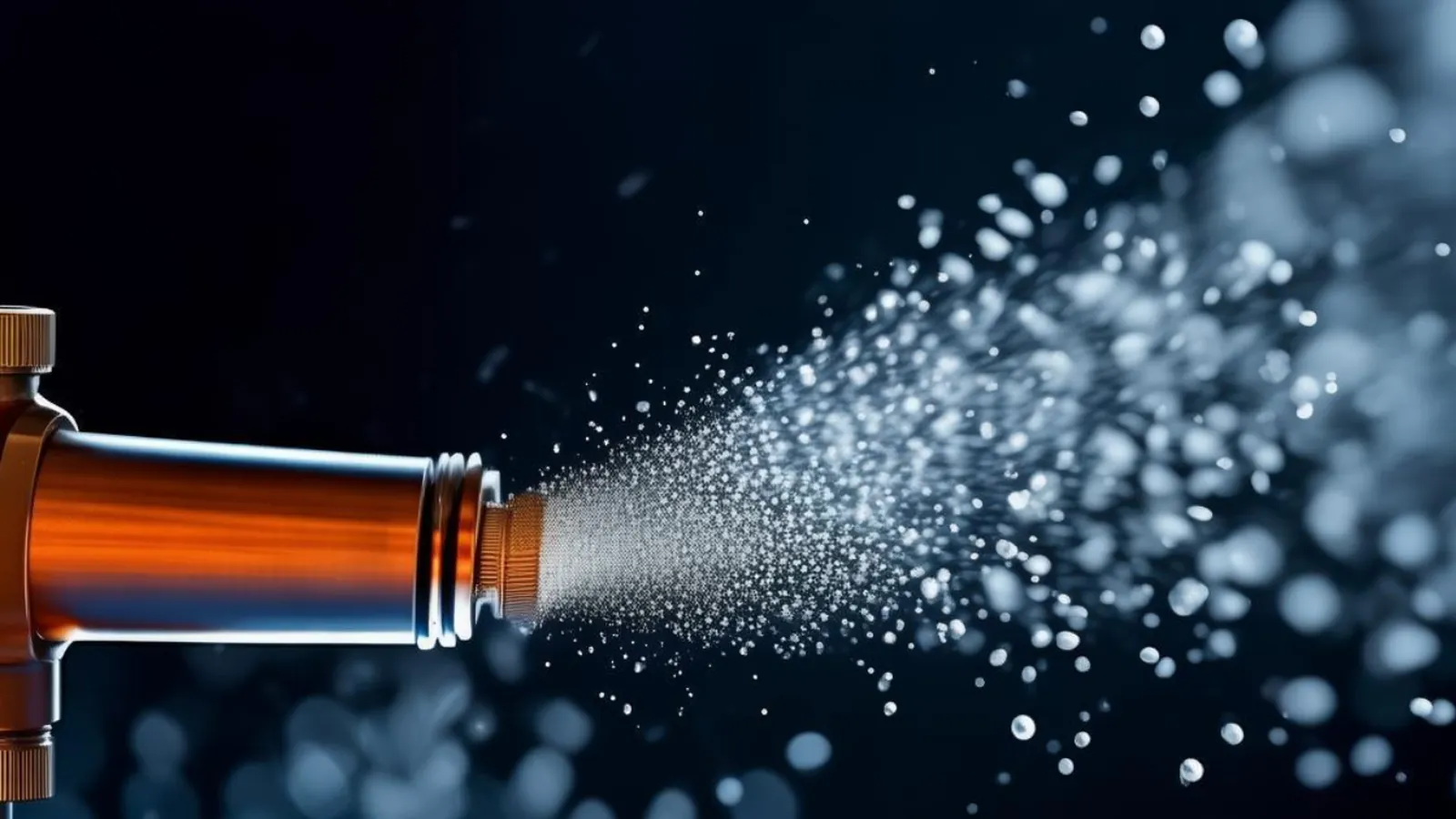
An atomizer is any device that breaks a liquid into a spray of droplets. The liquid enters as a stream and leaves as millions of small drops: from coarse 500 µm globules for dust wetting down to 10 µm mist for cooling and coating. The droplet size, the spray shape and the flow rate are set by how the atomizer converts energy into surface area.
That one sentence is the whole business: atomization is the conversion of liquid into surface area. A litre of water has a surface area of about 0.05 m² as a solid mass; atomized into 100 µm droplets it has roughly 60 m², a thousandfold increase. Every industrial use of a spray, evaporation, coating, combustion, cooling, reaction, dust capture, depends on that surface area. So choosing an atomizer is choosing how much surface area you get, at what flow, and with what droplet size distribution.
The Four Ways an Atomizer Makes Droplets
There are four families of atomizer, distinguished by the energy source that does the breaking-up. All four exist because no single atomizer covers every flow and droplet requirement.
Hydraulic atomizers
The liquid itself is forced through an orifice under pressure, and the velocity energy turns into droplet formation. A swirl chamber spins the liquid so it exits as a thin conical sheet that breaks into drops; a slot makes a flat sheet; a spiral core makes a full cone with a large free passage.
- Droplet size: 50–2,000 µm depending on pressure, pattern and flow
- Pressure: typically 1–100 bar
- Flow: from under 1 L/min to hundreds of L/min
- Cost: lowest, no second energy source
- Limitation: droplet size is coupled to flow; you cannot get fine drops at low pressure with high flow
Hydraulic atomizers cover the great majority of industrial spray duty. The full cone range is the workhorse pattern; the flat fan range covers strip-type coverage; the spiral range handles dirty water.
Air-assisted atomizers (pneumatic)
Compressed air (1–6 bar) shears the liquid into droplets regardless of hydraulic pressure. Air and liquid meet inside the body (internal mix) or just outside (external mix). The air does the atomizing work, so liquid flow can be very small, from 0.5 L/h, and droplets very fine.
- Droplet size: 10–100 µm at typical settings (internal mix finer than external)
- Air consumption: roughly 3–30 Nm³/h depending on size and setting
- Flow: 0.5–200 L/h liquid
- Advantage: independent control of liquid flow and droplet size; fine mist at low liquid pressure
- Limitation: consumes compressed air continuously, operating cost
The air atomizing range covers internal mix, external mix and adjustable versions. These are the atomizers for coating, humidification, electronics cooling and any duty that needs drops under 100 µm from a small liquid flow.
Ultrasonic atomizers
A piezoelectric transducer vibrates a surface at ultrasonic frequency (20 kHz to several MHz); the vibration tears liquid off the surface as very fine, very uniform droplets. No high pressure and no compressed air, just electric power.
- Droplet size: 10–50 µm, tightly distributed
- Flow: typically 1–100 L/h per transducer, low flow
- Advantage: the most uniform droplet size of any atomizer; very fine; no air consumption; low energy
- Limitation: low flow per head; liquid must be clean; droplet size depends on frequency, so each transducer is tuned to a size band
Ultrasonic atomizers are used for medical nebulizers, precise humidification, coating thin films and laboratory aerosol generation.
Rotary atomizers
Liquid is fed onto the centre of a spinning disc or cup (5,000–30,000 rpm) and flung off the edge as droplets. Droplet size is set mainly by peripheral speed, which is independent of flow, so a rotary atomizer can atomize very large flows at consistent size.
- Droplet size: 20–250 µm depending on disc speed
- Flow: up to tens of tonnes per hour in spray drying
- Advantage: high flow with controlled size; handles viscous and slurry feeds
- Limitation: mechanical complexity, drive cost, footprint
Rotary atomizers dominate spray drying (milk powder, chemicals, ceramics) where throughput is the priority.
Atomized, Atomizing, Atomization: Reading One Word Three Ways
Spec sheets use three forms of the same word, and buyers read them as three different things. Atomization is the process: the conversion of a liquid stream into droplets. Atomizing describes the hardware that does it, as in atomizing spray nozzles or an atomizing air line. Atomized describes the result, a liquid that has already been broken into droplets, as in atomized fuel, atomized slurry or atomized water.
| Term in the spec | What it tells you | What it leaves open |
|---|---|---|
| Atomization | The process is required | Which family, which droplet size |
| Atomizing nozzle | The hardware breaks up the liquid | Whether air or pressure does the work |
| Atomized spray | The output is droplets, not a jet | The size distribution |
| Air-atomized | Compressed air carries the energy | Air consumption at your flow |
The definition of atomized is therefore narrow and useful: a liquid converted to droplets, whatever the energy source. When a quotation says only “atomized”, ask for the SMD at your operating pressure and the energy figure that produces it. That pair is the specification; the word on its own is not.
Droplet Size: The Specification That Decides Everything
The single most important number on any atomizer is the droplet size distribution, usually quoted as SMD (Sauter mean diameter) or VMD (volume median diameter). SMD is the diameter of the drop whose volume-to-surface ratio equals that of the whole spray, the number that matters for evaporation, heat transfer and reaction. VMD is the midpoint: half the spray volume is in smaller drops, half in larger.
As a working rule, SMD is roughly 0.7–0.9 × VMD for typical sprays. The table below shows what size does what in practice.
| Droplet size | What it does | Typical atomizer |
|---|---|---|
| < 20 µm | Evaporates in a fraction of a second; drifts | Ultrasonic, high-pressure misting |
| 20–100 µm | Fine mist for coating, humidification, cooling | Air-assisted, high-pressure misting |
| 100–300 µm | Coarse mist; wets surfaces without pooling | Hollow cone at 3–7 bar, misting |
| 300–1,000 µm | General washing, scrubbing, fire protection | Full cone, flat fan |
| > 1,000 µm | Heavy wetting, dust suppression | Spiral, high-flow full cone |
For the maths behind the number, SMD, VMD and how to calculate them from nozzle data, see the droplet size calculation guide.
How Atomizer Choice Maps to Duty
Work through the duty, not the catalogue:
- Flow required: litres per minute or per hour. This narrows the family immediately: above ~20 L/min, hydraulic; below ~5 L/h at fine size, ultrasonic; the middle band belongs to air-assisted and hydraulic at higher pressure.
- Droplet size required: fine (under 100 µm) pushes toward air-assisted, ultrasonic or high-pressure hydraulic misting; coarse (above 300 µm) is satisfied by any hydraulic pattern.
- Pressure and utilities available: compressed air on site? Air-assisted is simple. Only electric power? Ultrasonic. Pump pressure available? Hydraulic.
- Fluid properties: viscosity kills fine atomization: a viscous liquid needs more energy per unit surface, so air-assisted or rotary outperform hydraulic at the same viscosity.
- Duty cycle and cost: air consumption is an operating cost; ultrasonic transducers are a capital cost; hydraulic is cheap to run and cheap to buy.
| Duty | Typical atomizer answer | Why |
|---|---|---|
| Coating a part with a thin even layer | Air-assisted | Fine, controllable, low flow |
| Cooling a gas stream | Hollow cone hydraulic | High flow, fine enough to evaporate |
| Humidifying a room | Ultrasonic or air-assisted | Fine droplets that evaporate fully |
| Washing a tank interior | Full cone hydraulic | High flow, coarse, cheap |
| Spray drying a slurry | Rotary | Huge flow at controlled size |
| Dust suppression on a stockpile | Spiral or wide-angle full cone | Coarse drops, no drift, anti-clog |
Common Atomizer Mistakes
Buying on droplet size alone. A 30 µm claim means nothing without the flow at that size, the pressure or air consumption, and the distribution width. Ask for SMD at your operating pressure, not a brochure number at an idealised setting.
Using high pressure to force fineness. Droplet size falls with the square root of pressure, roughly. Doubling pressure cuts diameter by about 30% but multiplies pump cost and wear. Air-assisted gives the same fineness at a fraction of the liquid pressure.
Ignoring air cost. An air atomizer running 8 hours a day at 12 Nm³/h consumes roughly 100 m³ of compressed air daily, at typical compressor costs of 0.1–0.15 kWh per Nm³, that is real money. If the duty can be met with hydraulic atomization, it usually should be.
Matching the pump to the spray, not the reverse. A full cone nozzle at 3 bar needs a pump curve, not a guess. Flow scales with the square root of pressure, so a pump that delivers 30% more pressure delivers about 14% more flow, and the nozzle sprays wider and finer than rated.
Atomizer Terms You Will Meet
- SMD / VMD: mean and median droplet diameters (see above)
- Internal / external mix: where air meets liquid in an air-assisted atomizer
- Spray angle: included angle of the cone or sheet at a reference pressure
- Free passage: largest particle that can pass without blocking
- Turndown: ratio of maximum to minimum controllable flow
- Air-to-liquid ratio (ALR): mass of air per mass of liquid; higher ALR means finer drops and more air cost
The Physics: Why Drops Form and How Small They Get
Atomization is driven by a competition between two forces. The kinetic energy of the liquid (or the air, or the vibrating surface) tries to stretch and tear the liquid into drops; surface tension tries to pull it back into the smallest stable sphere. A drop becomes stable when surface tension wins: the classic Weber number relationship that every sizing engineer works with in the background.
Three practical consequences follow from that physics:
Droplet size falls slowly with pressure. For a hydraulic atomizer, droplet size is roughly proportional to the inverse square root of pressure. Doubling the pressure cuts diameter by about 30% and multiplies flow by about 41%. Pushing a hydraulic atomizer from 3 bar to 12 bar gets you roughly half the droplet diameter, at four times the pump energy and much higher wear on orifice and seals. This is why air-assisted atomizers exist: they put the energy into the air, not the liquid.
Surface area is what does the work. Every application, evaporation, coating, reaction, cooling, scales with the surface area of the spray. A 100 µm spray has ten times the surface area of a 1 mm spray at the same water flow. Halving droplet size doubles surface area. That is the entire return on finer atomization.
Small drops evaporate quadratically faster. Evaporation time scales with the square of the diameter (the d² law). A 10 µm droplet evaporates in a few milliseconds; a 1,000 µm droplet takes on the order of a hundred times longer. Any duty that needs the droplets gone before they land, adiabatic cooling, humidification, gas conditioning, lives or dies by this relationship.
Atomizer Energy: The Operating-Cost Reality
Every atomizer family pays for its surface area differently:
| Atomizer | Energy source | Typical cost per hour at 20 L/h liquid | Notes |
|---|---|---|---|
| Hydraulic | Pump pressure | Low (pump energy only) | Cheapest to run; size coupled to flow |
| Air-assisted | Compressed air 3–30 Nm³/h | Medium–high (0.1–0.15 kWh/Nm³) | Independent flow/size control |
| Ultrasonic | Electricity | Low (transducer power) | Low flow per head |
| Rotary | Motor + disc | Medium (drive energy) | High flow, mechanical upkeep |
A useful rule for air-assisted systems: air consumption of roughly 0.1–0.3 m³ of air per litre of liquid atomized (internal mix) and 0.15–1.4 m³ per litre (external mix) covers the practical range. If your quoted air consumption sits far outside that band, the figure deserves a second look.
Application Walkthroughs
Coating and lubrication. Air-assisted atomizers dominate because coating needs a thin, even film: droplets of 20–80 µm that wet and level without runs. External mix gives independent air and liquid adjustment so the operator can tune pattern width and wetness live. Hydraulic flat fans handle heavy, high-flow coating lines where film thickness matters less than throughput.
Cooling. Two very different duties share the word. Evaporative cooling (gas quenching, tower pre-cooling, electronics spot cooling) wants small drops that evaporate fully: hollow cone hydraulic at 3–7 bar, air-assisted under 100 µm, or high-pressure misting at 40–70 bar for 10–50 µm. Impingement cooling (steel strip, molds) wants the opposite: coarse high-velocity drops that hit hard, flat fans and full cones at 1–10 bar. Choosing the family is choosing the cooling mode first.
Humidification. The droplet must evaporate before it lands, so size drives everything: ultrasonic or air-assisted for fine mist, high-pressure misting for large spaces. Coarse “humidifiers” that rain on the floor are sizing mistakes, not equipment failures.
Dust suppression. This is the coarse end: droplets of 300–1,000 µm that wet particles and fall with them. Wide-angle full cones and spirals are the standard answer because they are cheap, high-flow and clog-resistant. A fine mist here is wrong: fine drops evaporate before they reach the dust.
Combustion. Oil burners and gas turbines atomize fuel to expose surface area to the flame. Hollow cone nozzles at 100 psi (about 7 bar) with GPH-rated flows are the classic oil burner configuration; air-assisted and rotary atomizers handle heavy oils and slurries where hydraulic pressure cannot reach fine enough sizes.
Atomizing Spray Nozzles on Sprayers: Agriculture and Mobile Equipment
An atomizing spray nozzle on a field sprayer is chosen for drift, not for coverage. Smaller droplets travel further off target, so regulation and label constraints drive the nozzle class rather than operator preference. Three arrangements dominate mobile equipment.
| Sprayer type | How it atomizes | Droplet band | Why it is used |
|---|---|---|---|
| Boom sprayer, broadcast | Hydraulic flat fan at 2-4 bar | Medium to very coarse | Coarse drops land; drift rules met |
| Air-assisted orchard sprayer | Air shear in the air stream | Fine to medium | Carries droplets into the canopy |
| CDA or rotary atomizer | Spinning cage or disc | Narrow, 50-150 µm | Controlled size at low liquid rates |
Air-assisted sprayers are the clearest case of atomization selling the machine: the air stream breaks the liquid into droplets and then carries them to the target, so a tower or cannon reaches over a canopy that a boom cannot. The penalties are the ones that follow any pneumatic atomizer: continuous air cost and sensitivity to oil or water in the air supply. An atomization sprayer of the boom type is simpler, because the atomizer is just the tip: the flat fan in the agricultural range does the work at line pressure and the tip code sets the droplet class, with no air supply involved. The agricultural nozzle types guide decodes those tip codes, and the sprayer nozzle selection guide covers the boom setup around them.
Atomizer Selection Decision Table
| Your constraint | Family to start with | Confirm before buying |
|---|---|---|
| Flow above ~20 L/min, coarse OK | Hydraulic full cone / flat fan | Angle, material, free passage |
| Flow under ~5 L/h, need fine | Ultrasonic | Frequency ↔ droplet size, liquid cleanliness |
| Fine drops + small liquid flow | Air-assisted | Air consumption, mix type, SMD at your pressure |
| Huge flow + controlled size | Rotary | Peripheral speed, viscosity limits |
| No compressed air, no high pressure | Hydraulic at pressure or ultrasonic | Pump curve, transducer count |
| Dirty water, clogging feared | Spiral or large-passage full cone | Free passage vs solids size |
Atomizer FAQ
How much does it cost to run an atomizer? Depends on the energy source. Hydraulic atomizers run on pump pressure alone (typically 10–100 bar, no air cost). Air-assisted atomizers add compressed air at 1–6 bar, which is a continuous operating cost. A 5 Nm³/h air flow per nozzle at 0.3 kWh/Nm³ adds up over a 24/7 line. Ultrasonic and rotary atomizers sit in the middle: low air use, but the driver (piezo crystal or motor) has its own power draw and replacement interval. Price the duty, not the nozzle.
What is the smallest droplet size an atomizer can produce? Ultrasonic atomizers reach 1–10 µm; high-pressure hydraulic and air-assisted systems commonly produce 20–100 µm; rotary atomizers land around 20–120 µm depending on wheel speed. The practical limit is set by the application: droplets under 10 µm stay airborne and drift, which is desirable for humidification but a hazard for coating overspray.
Is an atomizer the same as a nozzle? A nozzle is the generic hardware that shapes a spray; an atomizer is the subset that actively breaks liquid into fine droplets. Every atomizer is a nozzle, but not every nozzle is an atomizer: a 120° full cone washing nozzle atomizes little.
What droplet size do I need for misting? If the mist must evaporate fully, stay under 100 µm, and prefer 10–50 µm for fast evaporation. Above 300 µm the “mist” lands wet. See the misting nozzle guide for the sizing walkthrough.
Can I get fine atomization without compressed air? Yes. High-pressure hydraulic misting (40–70 bar) reaches 10–50 µm, and ultrasonic atomizers reach 10–30 µm with electric power only. Both are low-flow solutions.
Why does my air atomizer consume so much air? Check the air-to-liquid ratio. External mix atomizers use two to three times the air of internal mix at the same liquid flow; adjustable versions run higher still. If the duty allows internal mix, air cost drops sharply.
What is the difference between SMD and VMD? SMD is the surface-area-weighted mean: the number that drives evaporation and heat transfer. VMD is the volume median: half the spray volume is finer. SMD runs about 0.7–0.9 × VMD on typical sprays. The droplet size calculation guide works through both.
Can an atomizer handle viscous liquid? With difficulty at the fine end. Viscosity resists sheet breakup, so viscous fluids need more energy per unit surface: rotary and air-assisted atomizers outperform hydraulic at viscosity above roughly 20–50 cP. Preheat is a common industrial fix.
How do I know the quoted droplet size is real? Ask for the droplet size at your operating pressure and flow, not the best-case figure. A spec that quotes 30 µm without pressure, flow and distribution width is a marketing number.
Atomizer Maintenance and Troubleshooting
Atomizers fail in predictable ways, and most failures are detectable before they ruin a batch:
Orifice wear. Abrasive liquid erodes the orifice and the spray gets coarser, wider and uneven over time. Stainless 303/316 orifices wear fastest with dirty water; hardened steel and ceramic inserts extend life by an order of magnitude. If the spray pattern starts drifting from spec, measure flow and replace: worn orifices pass more flow at the same pressure.
Internal blockage. Hard water scale, fibres and dried product plug small passages. Air-assisted atomizers with 0.5 mm liquid orifices are the most vulnerable; spirals and large-passage full cones are the most tolerant. A strainer upstream at the pump is cheaper than unblocking nozzles on a running line.
Air-side contamination. Oil and water in the compressed air supply change atomization and spoil coatings. Fit a filter-regulator at the atomizer, not just at the compressor. If the droplet size drifts on an air-assisted unit, check the air quality first.
Pressure drift. A pump that cannot hold pressure makes the spray coarser and narrower. Check flow at the nozzle, not the pump gauge. A 20% pressure drop is roughly a 10% flow drop and a visibly coarser spray.
Cleaning discipline. Never push wire through an orifice. It enlarges the passage and changes the rating. Soak in solvent and blow through with air. Keep spares of the sizes that run most often.
Sending an Atomizer Duty to BoreJet
Send the liquid, the flow (L/h or L/min), the target droplet size or the job itself (coating, cooling, humidification), the available pressure or compressed air, and any viscosity or solids notes. With those, the BoreJet team can point to the right family, and the right model, in one round, with figures rather than a catalogue number. The air atomizing range and high-pressure misting range are where most fine-atomizer inquiries land; the full cone range covers the coarse end.
Next Step
Send the Duty. Get Sized Nozzles Back.
Send your flow, pressure, fluid and target coverage. We come back with nozzle options and figures, not a catalogue number.
Written by
Ray ChanIndustrial spray nozzle specialist. I size tank cleaning, atomizing, flat-fan and spiral nozzles against real duty conditions, flow, pressure, fluid and target, rather than catalogue numbers. Every guide here comes from actual sizing work.